Web UI Walkthrough (Light & Dark)
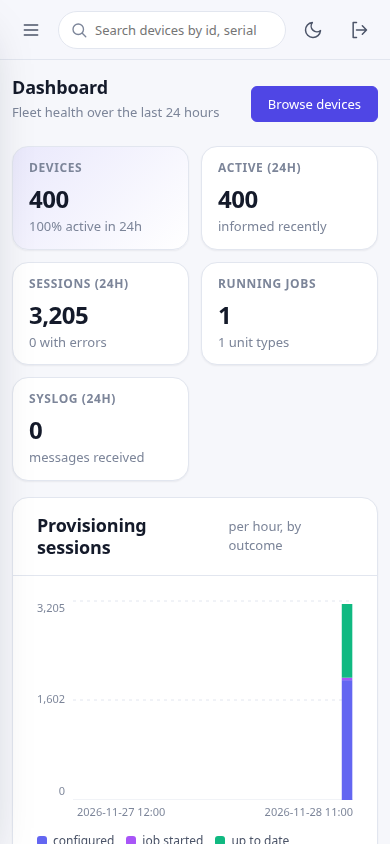
Tour the embedded Leptos SSR + WASM interface: fleet health dashboard, instant device search, TR-181 parameter tree, live on-demand Commands tab, staged canary firmware rollout progress, and TimescaleDB reports.
ferroacs is a ground-up, stateless Auto Configuration Server backed only by PostgreSQL + TimescaleDB. No Redis, no Kafka, no Hazelcast — with an embedded Leptos web UI, CLI, staged canary rollouts, and verified interoperability against SimulaTR69 and Broadband Forum OB-USP-Agent.
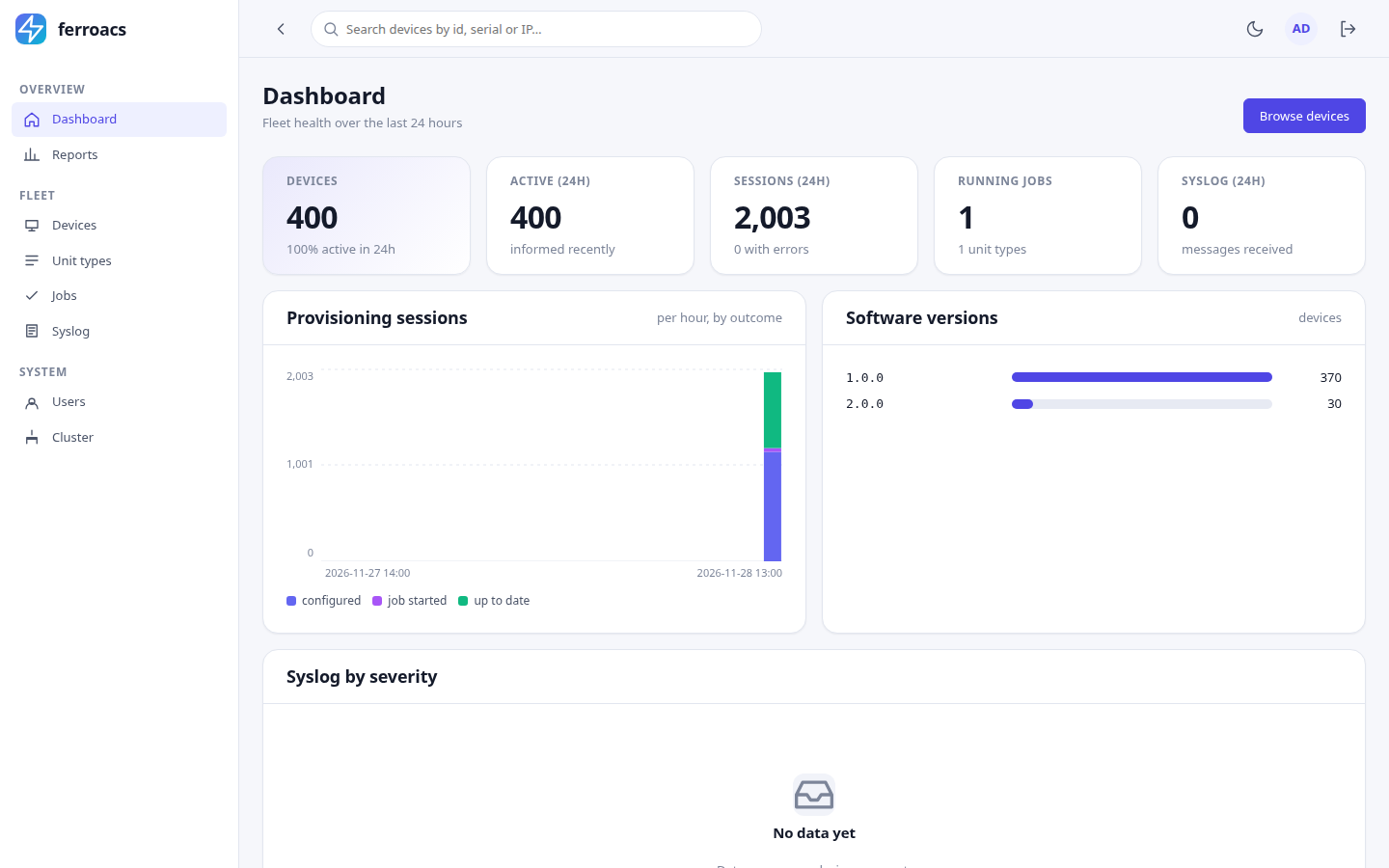
Recorded directly against a live ferroacs server managing hundreds of simulated devices — zero mockups.
Inspired by FreeACS, rebuilt from scratch in Rust against the Broadband Forum specifications.
Embeds CWMP, USP (WebSocket + MQTT 5), STUN, Syslog, REST API, job scheduler, and the Leptos web UI in one executable. PostgreSQL + TimescaleDB holds all state — no Redis, Kafka, or Hazelcast to babysit.
Run N identical nodes behind any load balancer. CWMP sessions, USP outstanding rounds,
E2E SessionContext SAR buffers, and background worker leases coordinate
cleanly via PostgreSQL SKIP LOCKED and advisory locks.
One protocol-agnostic device model, desired-config diff engine, service window planner, and command queue serves both legacy CWMP CPEs and modern TR-369 USP agents seamlessly.
Typestate CWMP sessions and USP rounds prevent illegal protocol transitions at compile time.
#![forbid(unsafe_code)], compile-time checked sqlx queries, and a
type-checked provisioning rule DSL validated before saving.
Push firmware, vendor configs, parameters, reboots, or kicks to hierarchical JSONPath
groups with deterministic canary stages, soak times, stop rules (a10/100),
job chains, and cluster-wide download concurrency limits.
Every protocol milestone is verified in CI/interop against independent implementations: SimulaTR69 (Go CWMP CPE) and Broadband Forum OB-USP-Agent over both WebSocket and MQTT 5 (plus TLS/mTLS).
Click any screenshot to inspect full resolution. Ships embedded inside ferroacs-server.
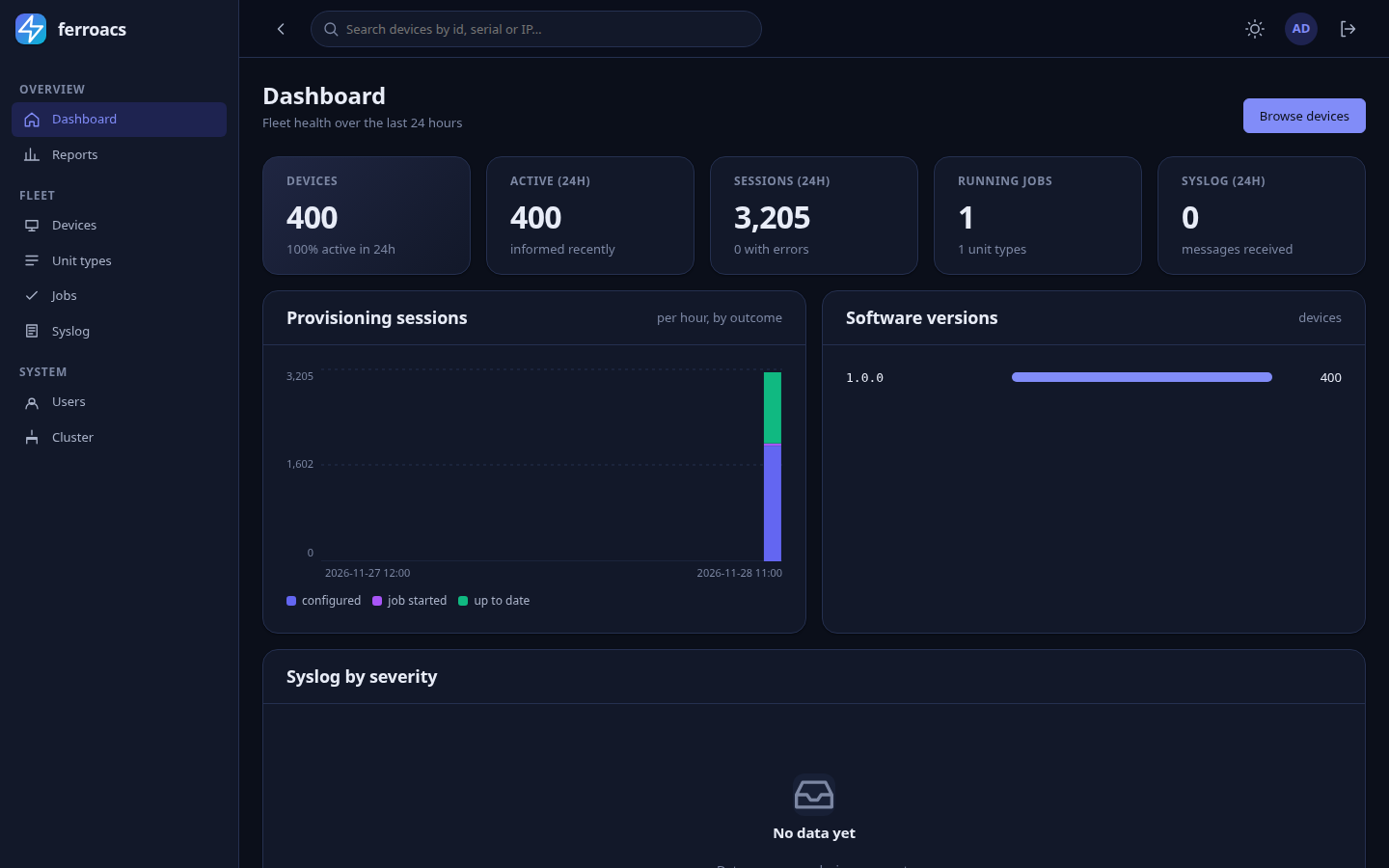
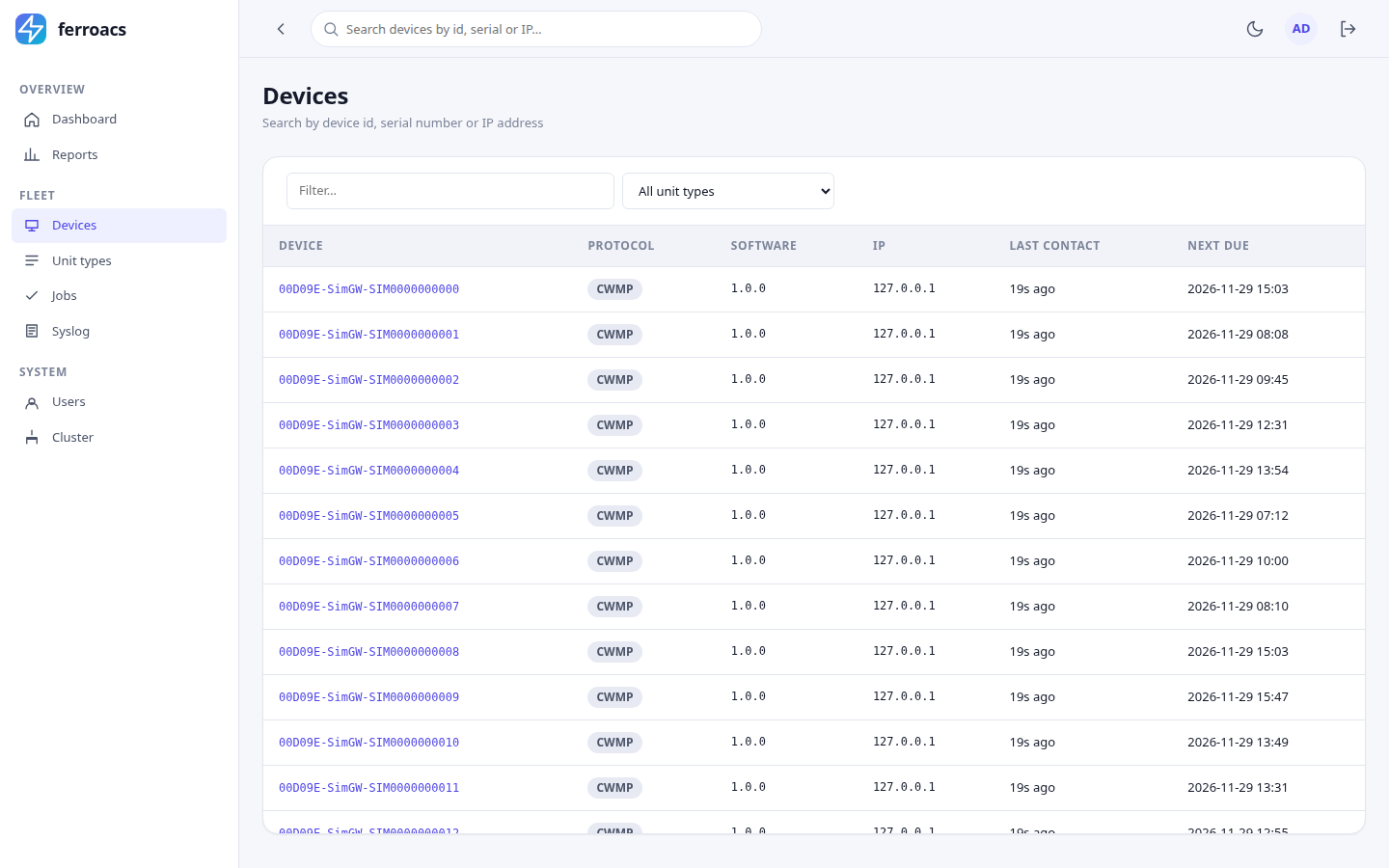
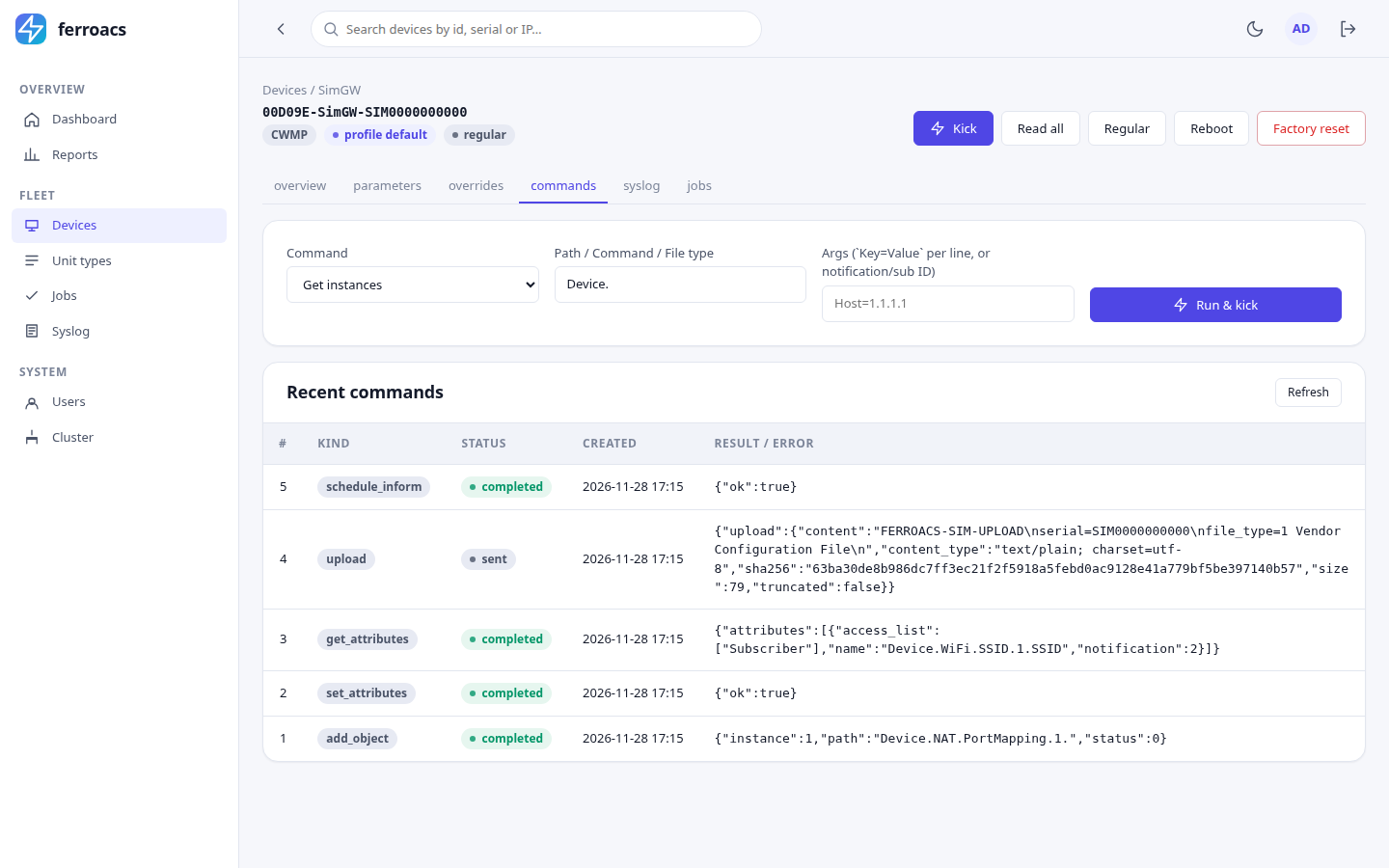
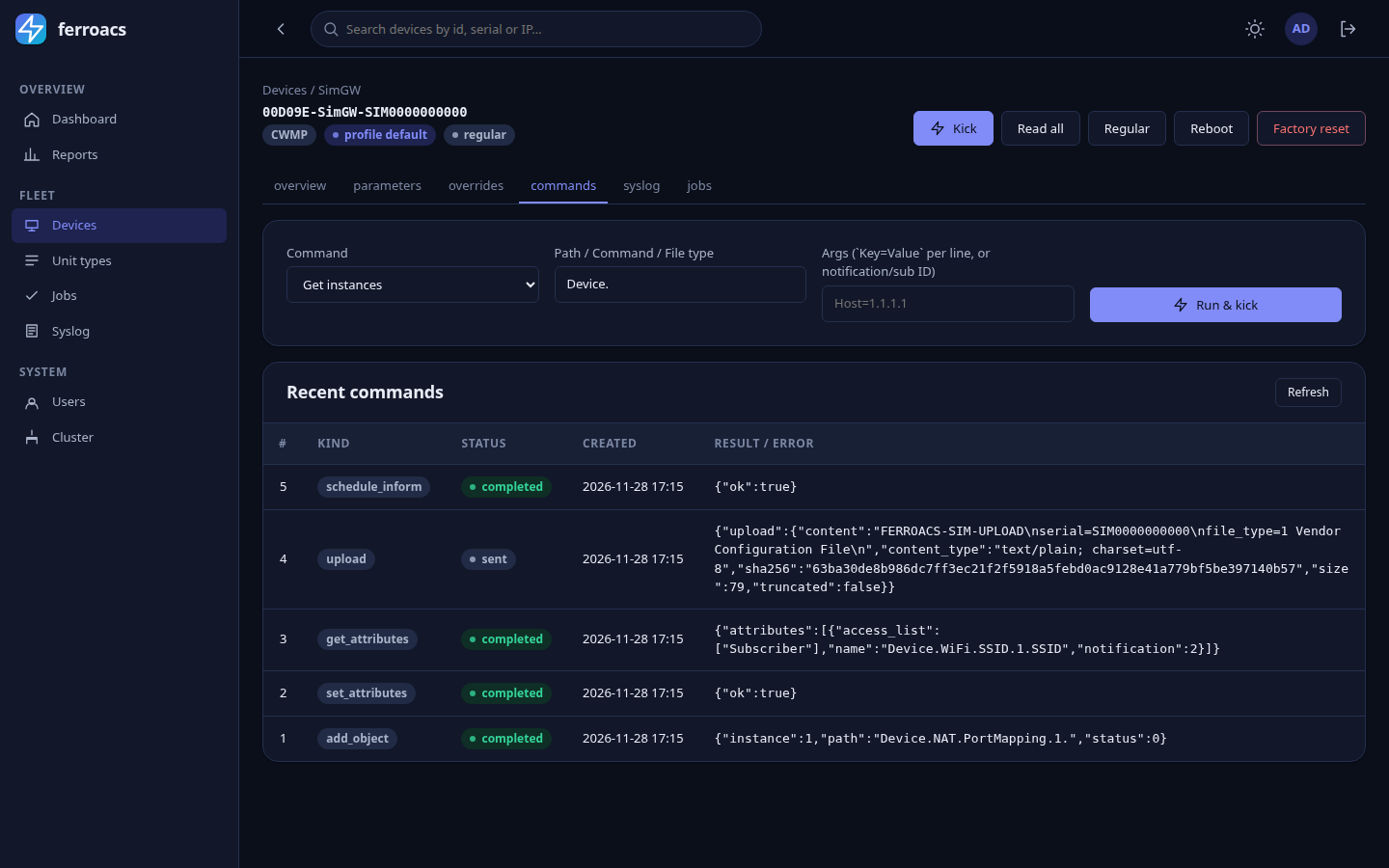
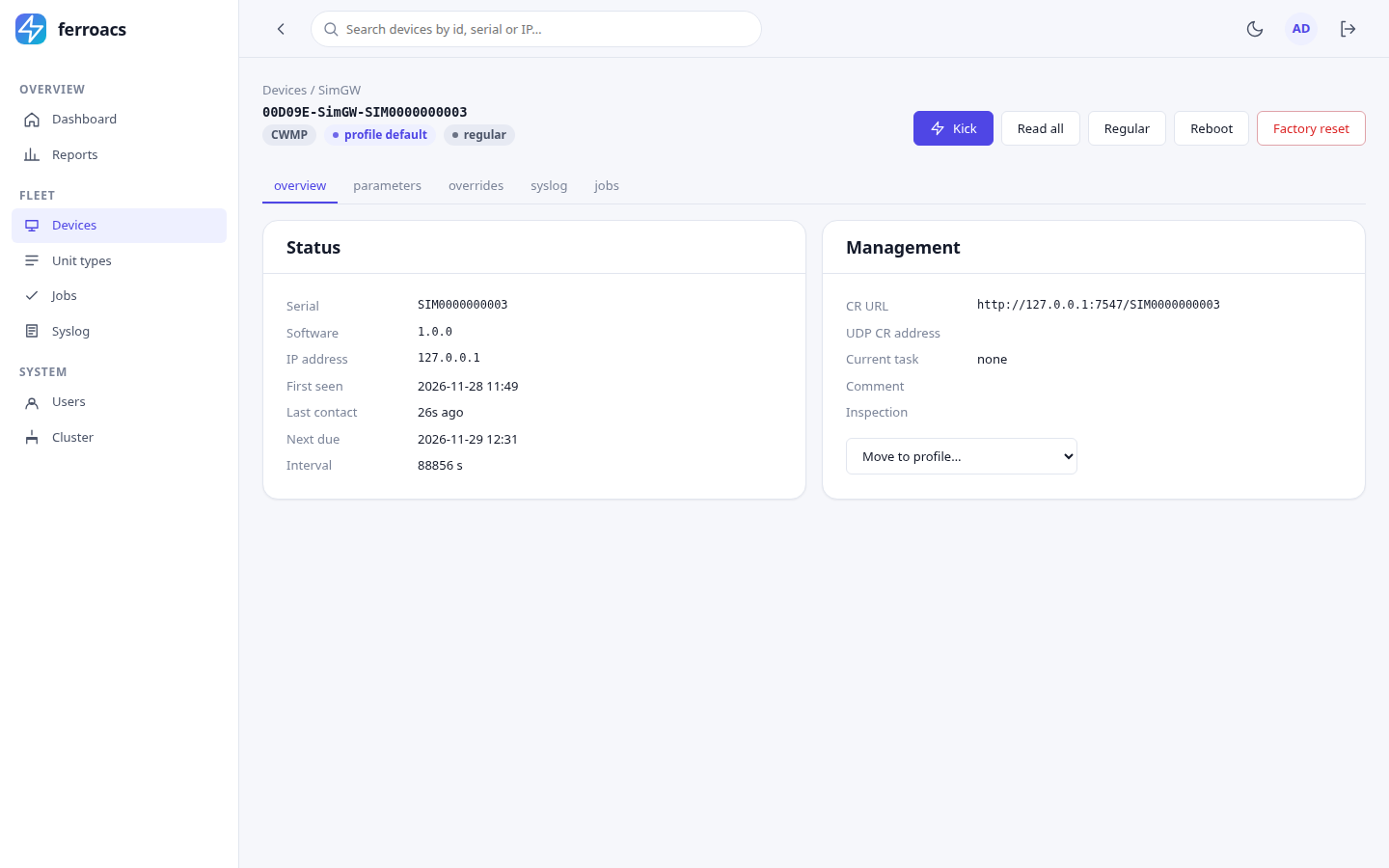
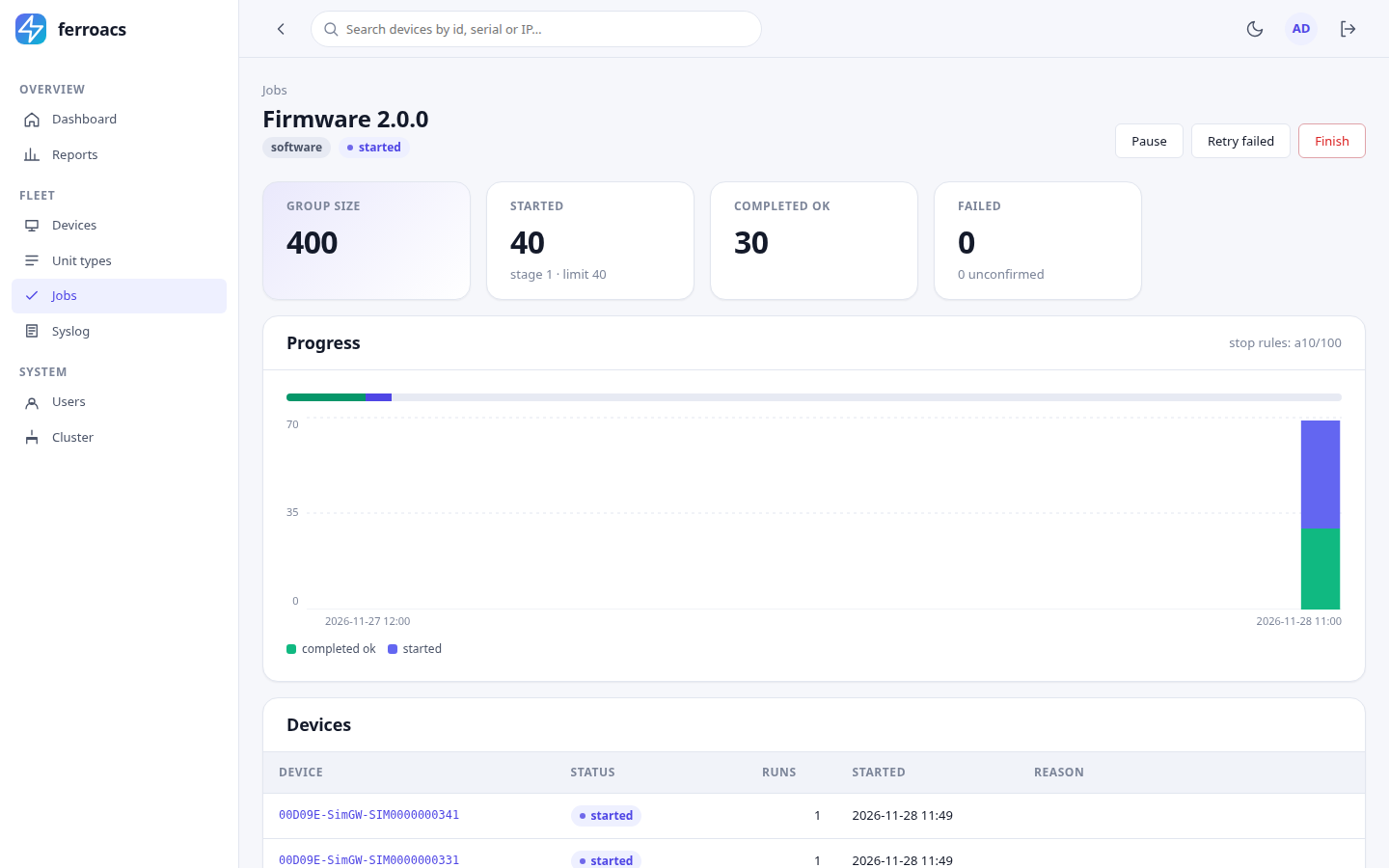
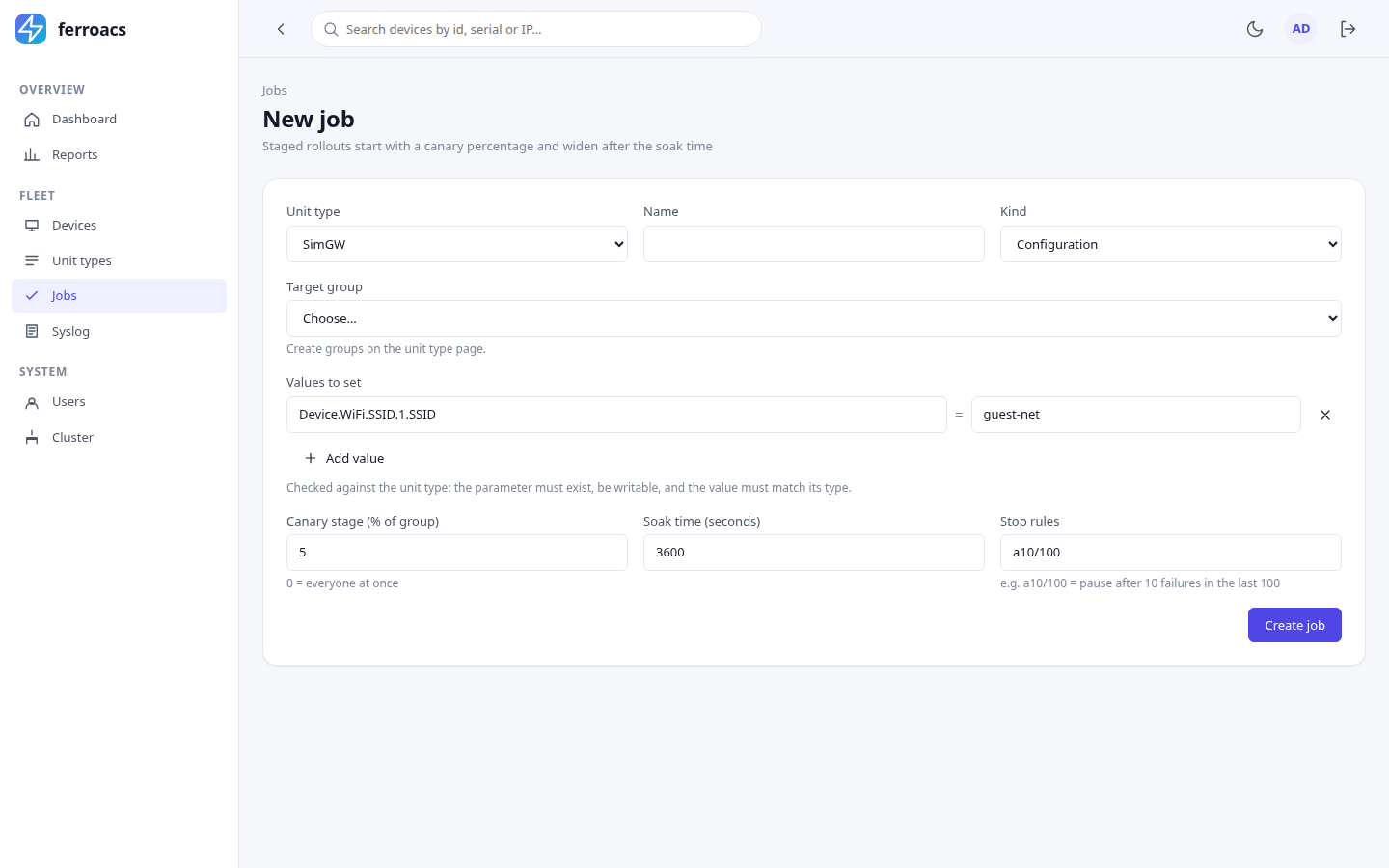
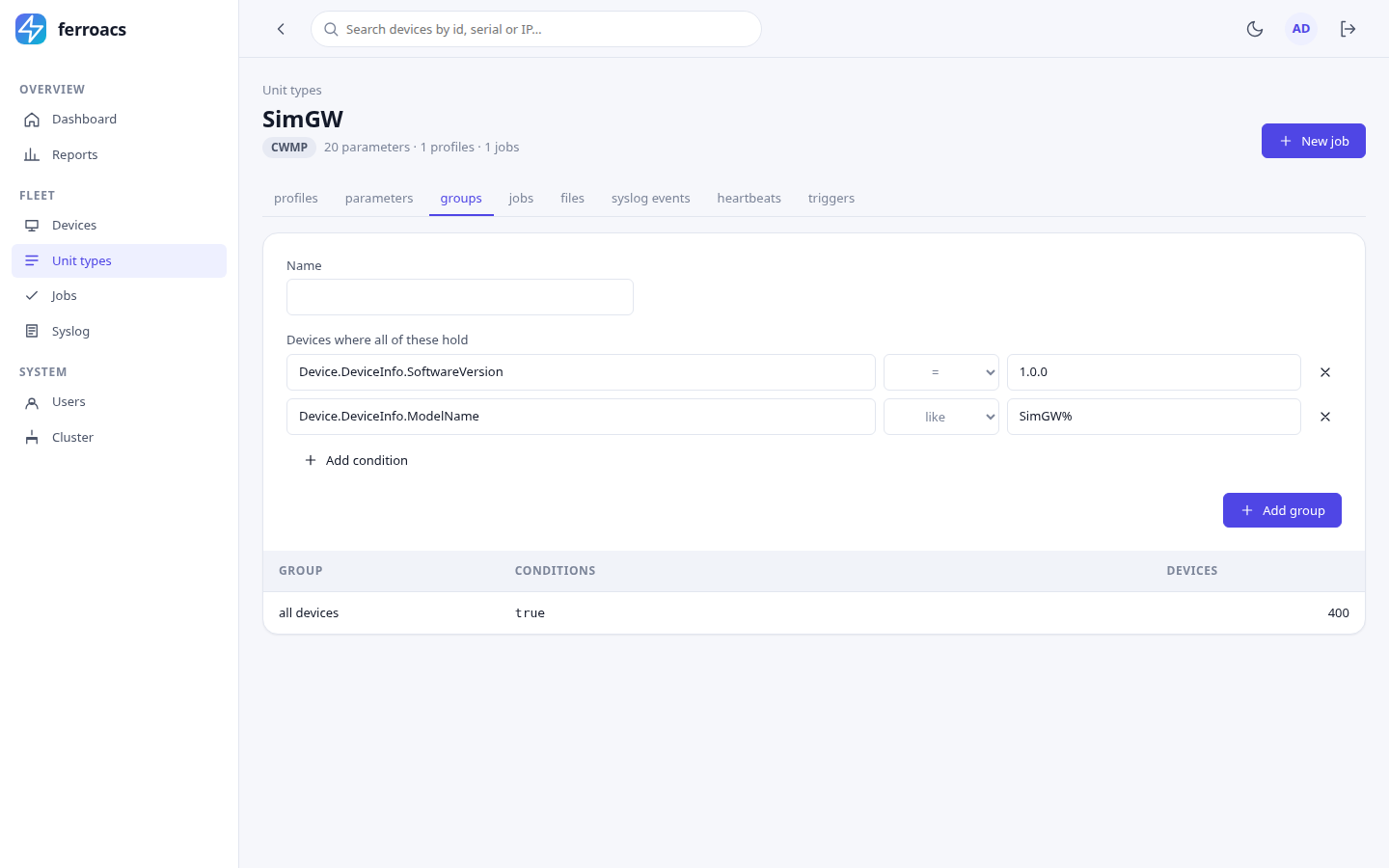
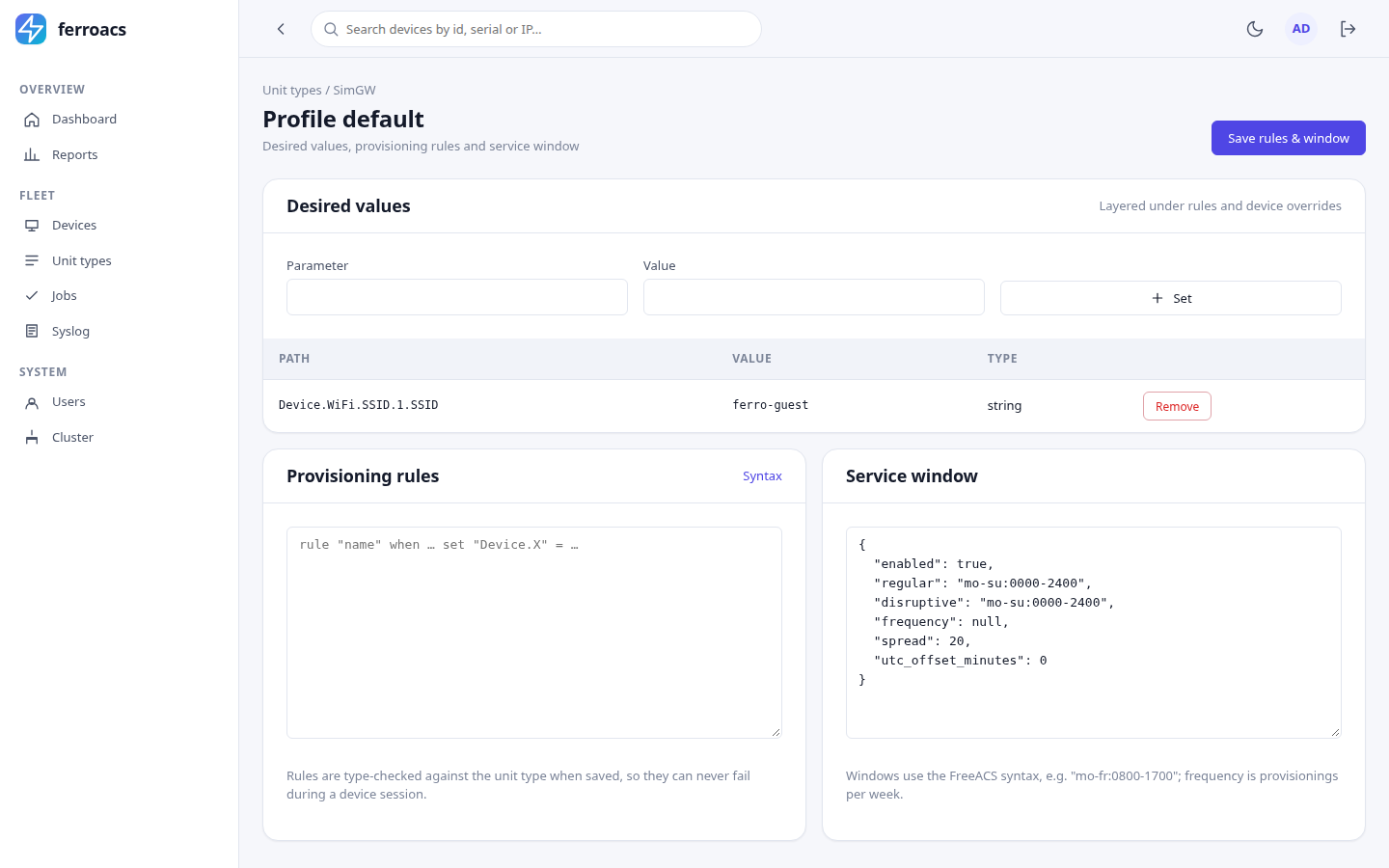
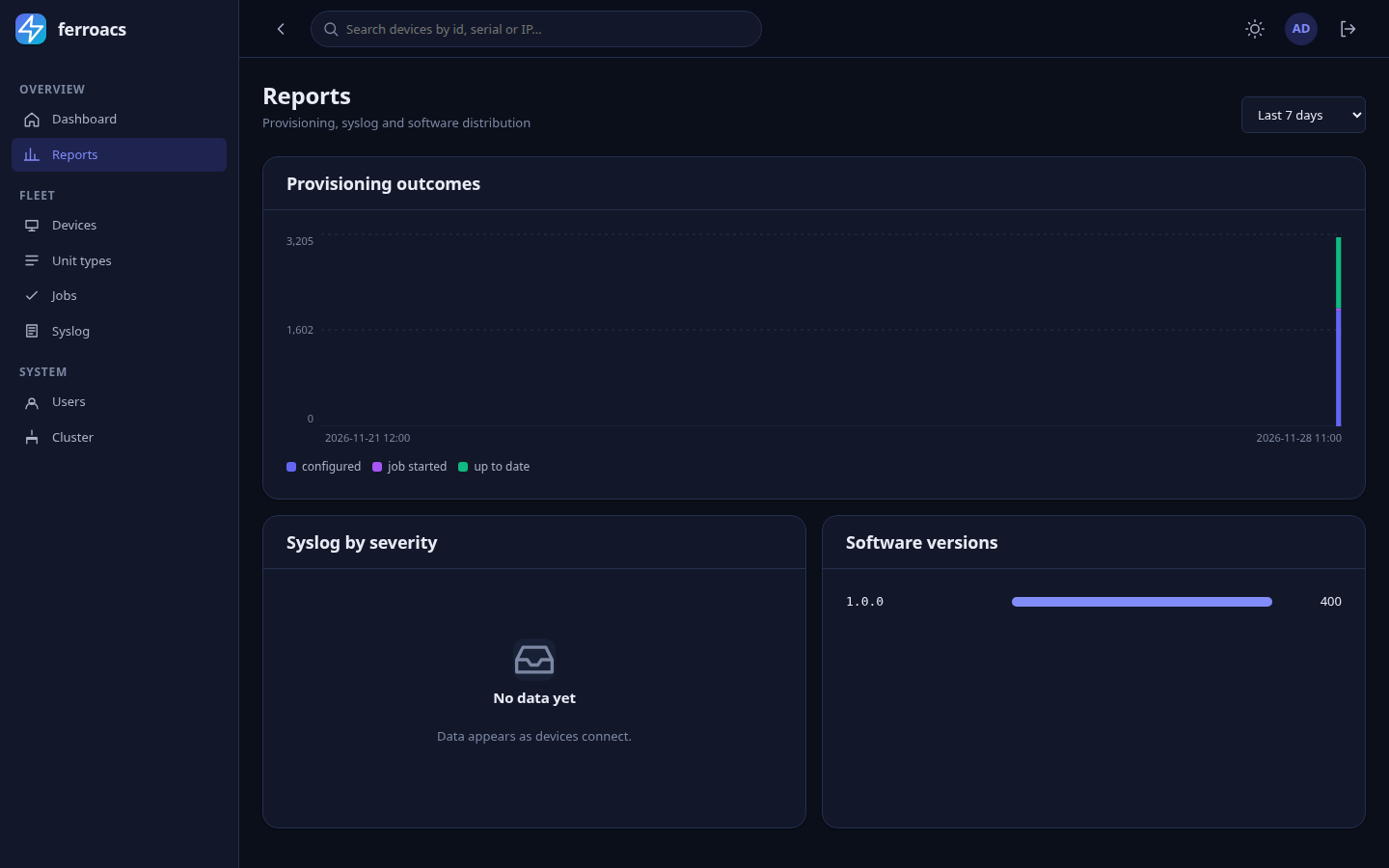
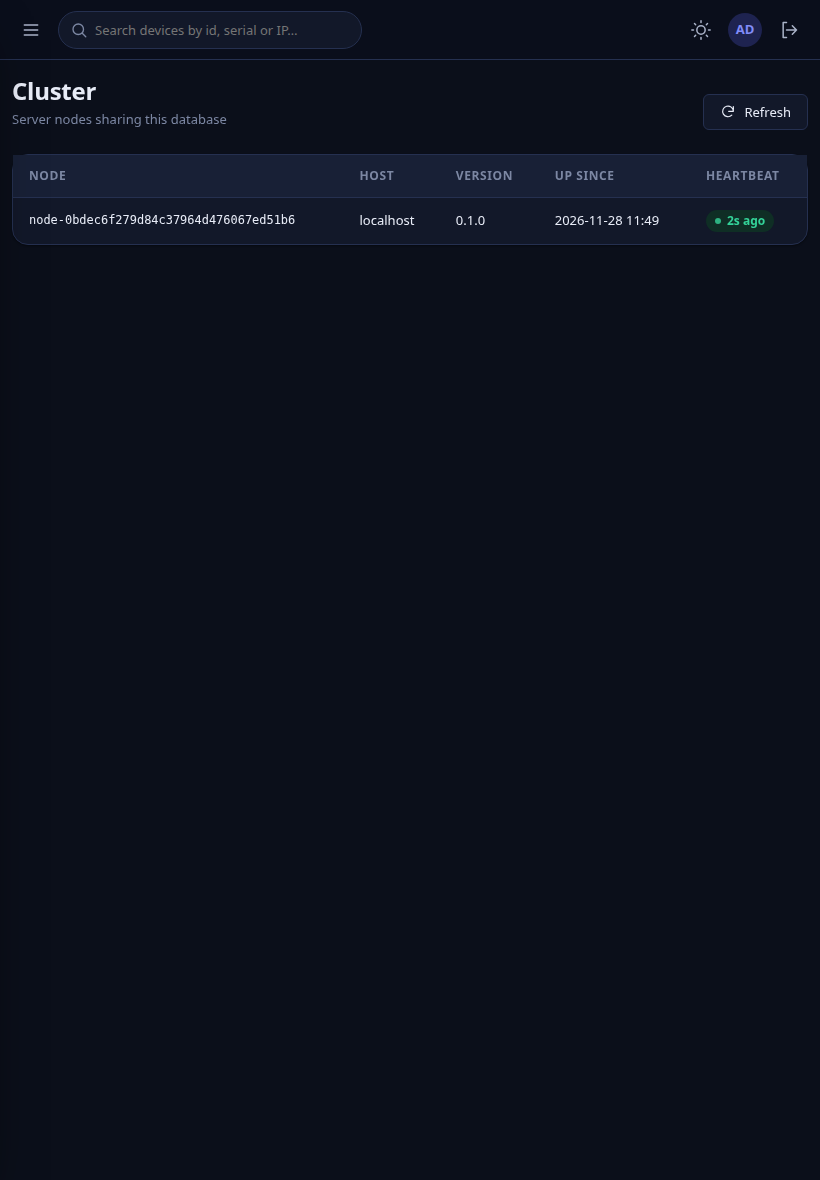
Both standards implemented natively with zero third-party ACS wrappers.
| Capability | TR-069 (CWMP 1.0–1.4) | TR-369 (USP 1.5) |
|---|---|---|
| Transport & Security | HTTP/S, Basic & RFC 7616 Digest auth (shared + per-device), cookie & IP fallback | WebSocket (v1.usp, cross-node Postgres outbox) & MQTT 5 with TLS/mTLS (rustls) |
| Session Layer | Typestate SOAP 1.1 sessions, ParameterKey 2-RTT fast path, CPE quirks |
NoSessionContext + persisted E2E SessionContext with SAR segmentation & reassembly |
| Discovery & Sync | Inform, GetParameterNames, GetParameterValues, SetParameterValues (incl. Status=1 reboot) |
OnBoardRequest, Boot!, Periodic!, GetSupportedDM, Get, Set, ValueChange live merge |
| Firmware & Files | Download + TransferComplete, Upload + PUT/POST /uploads/{id}/{token} sink |
Operate FirmwareImage.{i}.Download() + OperationComplete + post-boot verification |
| On-Demand Commands | AddObject (+ initial SPV), DeleteObject, Get/SetParameterAttributes, ScheduleInform, ChangeDUState + DUStateChangeComplete |
Add, Delete, GetInstances, GetSupportedProtocol, sync & async Operate, Subscribe / Unsubscribe |
| Wake-Up / Kick | HTTP Digest/Basic CR, TR-111 Annex G UDP CR, built-in STUN server | Direct controller-initiated rounds over active WebSocket or MQTT subscription |
Server, PostgreSQL 17 + TimescaleDB, and load generator sharing a single 8-core desktop (full methodology & tuning report).
| Benchmark Scenario | Target Rate | Achieved | Session p50 / p99 | HTTP p99 | Failed |
|---|---|---|---|---|---|
| 1M devices — post-reboot first contact (2 RPCs/session) | 116 / s | 116 / s | 5.0 / 6.1 ms | 2.2 ms | 0 |
| 100k warmed devices — steady state (fast path) | 116 / s | 116 / s | 3.1 / 3.9 ms | 2.2 ms | 0 |
| 10× mass-reconnect burst | 1,160 / s | 1,160 / s | 2.7 / 3.2 ms | 1.8 ms | 0 |
| Single-node ceiling probe (5,000/s offered) | — | 3,322 / s | ~285M sessions/day | — | 0 |
Grab prebuilt Linux binaries, launch Docker Compose with simulated devices, or inspect the CLI.
# 1. Clone and boot ferroacs + TimescaleDB + Mosquitto
git clone https://github.com/jarlah/ferroacs.git
cd ferroacs
docker compose up -d

# 2. Seed 50 simulated TR-069 devices immediately
docker compose exec ferroacs ferroacs-sim load \
  --acs http://127.0.0.1:8080/cwmp \
  --username acs --password acs \
  --devices 50 --rate 25 --duration 3

# 3. Open the Web UI at http://localhost:8080  (admin / admin-password)
# 1. Download & verify the latest release tarball from GitHub Releases
tar -xzf ferroacs-v*-x86_64-unknown-linux-gnu.tar.gz
cd ferroacs-v*-x86_64-unknown-linux-gnu

# 2. Prepare PostgreSQL 15+ with TimescaleDB
createdb ferroacs
psql ferroacs -c 'CREATE EXTENSION IF NOT EXISTS timescaledb'

# 3. Run ferroacs-server (migrations run automatically on startup)
FERROACS_DATABASE_URL=postgres://user:pass@localhost/ferroacs \
FERROACS_SECRET_KEY=$(openssl rand -hex 32) \
FERROACS_ADMIN_PASSWORD=change-me \
./ferroacs-server --config config/ferroacs.toml
export FERROACS_URL=http://localhost:8080
export FERROACS_USER=admin
export FERROACS_PASSWORD=admin-password

# Inspect cluster & fleet
ferroacs status
ferroacs device list

# Run live TR-069 & TR-369 protocol commands
ferroacs device add-object 00D09E-SimGW-0001 Device.NAT.PortMapping. --param ExternalPort=8080 --kick
ferroacs device upload 00D09E-SimGW-0001 --kick
ferroacs device operate os::00D09E-DEV1 "Device.SelfTestDiagnostics()" --kick
ferroacs device commands 00D09E-SimGW-0001